Assistant



 Free delivery serviceFree ground shipping in NYC 5 boroughs for orders over $150 and free ground shipping for all instock orders over $450
 Secure PaymentVisa, American Express, Mastercard...
 Guaranteed provenanceAuthenticity & Traceability of origin
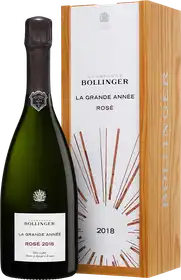
Bollinger : La Grande Année 2018
In stock. Available for pick-up at store
Let's talk about this product!
A pairing in mind? A question about the vintage? Comparison with another product? Find the answers here...
Description
Characteristics and Tasting Notes for Bollinger's La Grande Année 2018
Tasting
Appearance
A beautiful pale golden-yellow hue, the colour is enhanced by subtle bronze highlights.
Nose
The bouquet reveals itself as expressive and complex, unveiling aromas of white-fleshed fruits such as yellow apple and poached pear, accompanied by notes of Mirabelle plum and wildflowers. With aeration, nuances of light pastry, brioche, smoky minerality reminiscent of gunpowder, and biscuit unfold, bearing witness to the long ageing on lees.
Palate
On the palate, this champagne offers a broad, finely chiselled texture, carried by a persistent salinity. The balance between suppleness and vivacity is remarkable, with a phenolic structure that generously frames the fruit without ever dominating it. The finish lingers elegantly, leaving a mineral, slightly chalky impression that highlights the expression of the terroir.
Food and wine pairing
The "La Grande Année" 2018 cuvée is an ideal accompaniment to tuna carpaccio garnished with marinated vegetables such as daikon, white carrot and fennel, seasoned with lemongrass. This champagne also pairs beautifully with pan-seared veal medallions with garlic and sage, served with white lentils. Shellfish, crab and lobster also make excellent pairings.
Serving and cellaring
It is recommended to serve the "La Grande Année" 2018 cuvée at a temperature between 8 and 10°C. This champagne can be enjoyed now while also offering considerable cellaring potential, with an optimal evolution capacity extending to around 2035.
A delicate champagne with beautiful vivacity, a signature of Bollinger's excellence
The estate
Founded in 1829 in Aÿ by Athanase de Villermont, Paul Renaudin and Joseph Bollinger, the Bollinger House remains one of the rare family-owned and independent champagne houses. Now headed by Étienne Bizot, great-great-nephew of the legendary Madame Lily Bollinger, the House owns 178 hectares of vineyards, 85% of which are classified as grand cru or premier cru. Bollinger stands out for its commitment to traditional methods, notably fermentation in oak casks and the retention of a full-time cooper. The House has held the Royal Warrant for 140 consecutive years, an absolute record for a champagne house.
The vineyard
The "La Grande Année" 2018 cuvée is crafted from a blend of nineteen prestigious crus of Champagne. The grands crus of Aÿ and Verzenay, located in the Montagne de Reims, form the backbone of this champagne with their chalky soils that lend concentration and minerality to the grapes. These terroirs benefit from optimal exposure and a limestone geology that moderates climatic conditions, allowing for ideal ripening of the pinot noir. The chardonnay parcels come notably from Chouilly, Cuis and Avize, bringing freshness and elegance to the blend.
The vintage
The year 2018 in Champagne was marked by exceptional weather conditions. After a very rainy winter and spring, the summer proved extremely dry and hot, with 750 hours of sunshine between April and June. Budbreak occurred on 15 April and flowering on 30 May, ten days ahead of the ten-year average. Harvest began early, on 23 August, for the pinot noir. The grapes showed natural sugar levels above 10.4 degrees Brix, with particularly high tartaric acidity levels and very low malic acidity, ensuring a natural balance conducive to ageing.
Winemaking and ageing
The "La Grande Année" 2018 cuvée was vinified according to the House's traditional methods. All of the base wines were fermented in old oak casks from Burgundy, a practice maintained since 1829. The champagne then aged on lees for more than eight years, gradually developing its aromatic complexity. Riddling and disgorgement were carried out entirely by hand, following a method introduced in 2014 that uses the champagne's natural carbon dioxide to protect the wine from oxidation during disgorgement.
Grape varieties
Pinot Noir (66%), mainly from Verzenay, Aÿ and Mareuil-sur-Aÿ
Chardonnay (34%), from Chouilly, Cuis and Avize