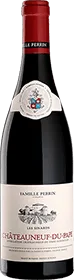
Famille Perrin : Les Sinards 2021

Out of stock
Would you wish to know when this product is back in stock?
Let's talk about this product!
A pairing in mind? A question about the vintage? Comparison with another product? Find the answers here...
Description
Characteristics and Tasting Tips for the Châteauneuf-du-Pape Blanc 2021 Famille Perrin
Tasting
Color
The wine shows a pale gold color.
Nose
The nose opens on white flowers and acacia, with notes of yuzu and fennel.
Palate
The palate is floral, ample yet balanced, and carried by lively tension. The finish is long, with lingering flavors of acacia, vineyard peach, and citrus.
A fresh, floral Châteauneuf-du-Pape Blanc from the Clos du Château
The Estate
Famille Perrin's story in the Rhone Valley begins in 1909, when Pierre Tramier acquired Château de Beaucastel, near Châteauneuf-du-Pape. His son-in-law, Pierre Perrin, later took over the estate. Today the property remains in the hands of Famille Perrin, with the fifth generation at the helm. The family has farmed organically since 1950 and converted Beaucastel to biodynamics in 1974. It has since expanded across several appellations of the southern Rhone Valley and Provence.
The Vineyard
This Châteauneuf-du-Pape Blanc comes from a walled vineyard of 2.5 hectares known as the Clos du Château, close to Châteauneuf-du-Pape. The Beaucastel team manages it, and it sits next to one of the parcels used for the Sinards red. The soils are alpine diluvium deposits of rolled pebbles and clay. The vines are farmed with the organic and biodynamic approach inherited from Beaucastel.
The Vintage
Famille Perrin describes 2021 as a "winemaker's vintage" marked by freshness, and compares it to vintages of the 1980s and 1990s. A frost in April and harvests interrupted by rain made the year challenging. It demanded constant attention in the vineyard from the teams.
Winemaking and aging
For the Châteauneuf-du-Pape Blanc 2021, maturity checks and berry tastings begin in August to determine the best harvest date. The grapes are pressed as soon as they reach the cellar in a pneumatic press. The must is then settled by cooling, with no additives. Fermentation starts in tank, and from the first day the must is moved to demi-muids, where fermentation continues. The wine ages for several months in these large barrels, with regular lees stirring. It is lightly fined before bottling.
Grape Varieties
Clairette, Grenache Blanc, and Roussanne. The proportions are not specified.