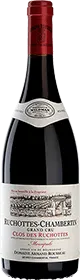
Armand Rousseau : Ruchottes-Chambertin Grand cru "Clos des Ruchottes" Monopole 2019
Only 1 available
In stock. Available for pick-up at store
Let's talk about this product!
A pairing in mind? A question about the vintage? Comparison with another product? Find the answers here...
Description
Tasting Notes and Serving Recommendations for the Ruchottes-Chambertin Grand Cru "Clos des Ruchottes" Monopole 2019 by Armand Rousseau
Tasting
Color
The wine displays a deep ruby to garnet hue, with notable depth and a clarity typical of a well-structured pinot noir from a ripe Côte de Nuits vintage.
Nose
The bouquet is complex and layered, opening on red and black fruit—cherry, wild strawberry, and plum—interwoven with rose petal and peony. Spice notes of anise and Chinese-style spice mingle with hints of black tea, bay leaf, menthol, grilled meat, and undergrowth, all framed by a distinct mineral edge.
Palate
The palate is energetic and precisely delineated, combining a muscular backbone with genuine elegance. Fine-grained, almost velvety tannins support a core of concentrated, saline fruit, while bright acidity keeps the wine ethereal and lifted rather than heavy. The finish is notably long and persistently saline, with a graphite-like mineral streak running through it.
Food and wine pairings
This cuvée pairs naturally with braised chicken cooked in a red Burgundy reduction, beef filet with truffle, and washed-rind cheeses such as Époisses, whose intensity meets the wine's structure and salinity in kind. More broadly, it suits refined preparations of poultry or game birds with spiced or smoky sauces, as well as delicately seared high-quality beef.
Serving and cellaring
The Ruchottes-Chambertin Grand Cru "Clos des Ruchottes" Monopole 2019 is best served around 16°C to preserve its aromatic finesse and mineral lift. According to retailer recommendations, this cuvée is ideally enjoyed after 10 to 20 years of cellaring, suggesting an optimal drinking window from approximately 2029 to 2039.
Other characteristics
The wine shows an alcohol level of around 14% by volume.
Clos des Ruchottes: A Monopole Grand Cru from Gevrey-Chambertin's Upper Slopes
The Estate
Armand Rousseau founded the domaine in Gevrey-Chambertin, Burgundy, in 1909, after inheriting family vineyard holdings. Over four generations, the estate built one of Burgundy's most respected grand cru portfolios, becoming a pioneer in estate bottling in the 1920s and 1930s. Today the domaine spans 15.33 hectares and is led by Cyrielle and Eric Rousseau, who continue the family's terroir-driven, low-intervention philosophy centered entirely on pinot noir.
The Vineyard
The Clos des Ruchottes is a walled, 1.06-hectare monopole located in the upper section of the Ruchottes-Chambertin grand cru, known as Ruchottes-du-Dessus, at an altitude of roughly 295 to 320 meters. The soil is shallow, stony, and highly calcareous, sitting atop Comblanchien limestone, with a slope of around 10 to 15% and an east-southeast exposure. Vines average 40 to 45 years of age and are planted at a high density of about 11,000 vines per hectare. The domaine farms this plot using ecological practices, avoiding insecticides and herbicides, relying on mechanical soil work, green harvesting, and leaf thinning to maintain balance and concentration.
The Vintage
The 2019 vintage in Burgundy is widely regarded as an exceptional year, combining strong phenolic ripeness, good concentration, and well-preserved acidity, often described as a near-ideal balance of growing conditions across the region.
Winemaking and aging
For the Ruchottes-Chambertin Grand Cru "Clos des Ruchottes" Monopole 2019, fermentation takes place in open stainless steel vats over roughly 18 to 20 days, with regular punch-downs and pump-overs, reaching a maximum temperature of about 31 to 34°C. The wine is pressed using a pneumatic press before undergoing malolactic fermentation in oak barrels sourced from the Allier forests. Aging lasts around 18 months, with approximately 30% new oak, including two rackings. The wine is bottled by gravity in the spring, following a light plate filtration.
Grape Varieties
100% pinot noir.