Founded in 1879 in Rioja Alta, CVNE has established itself over nearly one hundred and fifty years as one of Spain’s most respected bodegas. Driven by five generations of the Real de Asúa family, the Compañía Vinícola del Norte de España now brings together four distinct estates, each true to the identity of its terroir, composing a complete panorama of the DOCa Rioja, from its most confidential whites to its most ambitious reds.
Four bodegas, one shared pursuit of excellence in the heart of Rioja
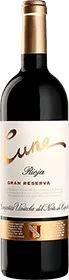
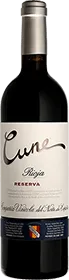
Cune Reserva and Gran Reserva: at the gateway to a century-old legacy
Born from a printer’s error that became legend (the V in CVNE turned into a U), the Cune brand has embodied the classic style of Rioja Alta since 1879. The Reserva delivers a straightforward, full-bodied tempranillo, with tannins polished by measured aging in oak barrels, a faithful reflection of its original terroir.
The Gran Reserva takes on a broader register. More rigorous selection and extended aging give the wine greater depth and aromatic complexity without ever sacrificing the elegance that defines this historic cuvée.
Imperial Reserva and Gran Reserva: the controlled power of Rioja Alta
The flagship of the house since 1920, Imperial draws its substance from the finest plots in Villalba and Torremontalbo. The Reserva, built on tempranillo and complemented by graciano and mazuelo, unfolds a dense tannic structure wrapped in notes of black fruit and spice.
Twenty-four months in barrel followed by three years in bottle shape the Gran Reserva. This extended time reveals a wine of rare concentration, with hints of graphite, tobacco, and licorice, crafted to stand the test of time.
Viña Real Reserva and Gran Reserva: the elegance of Rioja Alavesa
From its spectacular bodega perched on the hills of Laguardia, Viña Real expresses the distinctive aromatic profile of Rioja Alavesa. The Reserva cuvée charms with its roundness, floral notes, and natural freshness enhanced by altitude.
With the Gran Reserva, Viña Real reveals the full expression of the Alavesa terroir. Structured and precise, this wine combines careful aging with vibrant fruit, supported by remarkably fine tannins.
Contino Reserva and Gran Reserva: Rioja’s first “château”
The first Rioja wine produced from a single estate, Contino was created in 1973 and spans 62 hectares. The Reserva cuvée reflects the mosaic of alluvial, clay-limestone, and sandy soils that make this site unique.
Dense and mineral, Contino Gran Reserva pushes this parcel-driven approach even further. Strict selection and French oak shape a wine marked by saline tension, the true signature of the estate.
Real de Asúa “ Carromaza ”: single-parcel ambition
At the top of the hierarchy at CVNE, the Real de Asúa “ Carromaza ” cuvée is born from vines in Villalba, planted at high density on limestone soils. Here, tempranillo reaches a rare level of concentration and purity of expression.
Each vintage reflects a resolutely parcel-based philosophy. Aging in new French oak enhances the substance without masking it, delivering a wine of breadth and typicity that embodies one of the house’s most accomplished expressions.
Monopole Clásico Reserva and Gran Reserva: the white legacy of 1915
A rare heritage in the Rioja landscape, Monopole was the first registered white wine of Spain in 1915. The Reserva, made from viura, offers a profile with notes of dried fruit and almond, shaped by oak aging.
In Gran Reserva, extended aging elevates this singularity even further. Aromatic density, minerality, notes of wax and honey: a know-how that remains confidential today, faithful to the founding spirit of the bodega.
From Barrio de la Estación to the heights of Rioja, nearly 150 years of history
Haro and Barrio de la Estación: the origins
In northern Spain, the town of Haro enjoys a privileged location at the confluence of the Ebro and the Tirón, in the western part of Rioja Alta. It is in its Barrio de la Estación, a historic district home to the region’s oldest bodegas, that CVNE established its foundations in 1879.
The Real de Asúa brothers and the birth of a legendary name
Two Basque brothers, Eusebio and Raimundo Real de Asúa, were behind this winemaking venture. The phylloxera epidemic that was devastating French vineyards at the time drove Bordeaux merchants toward Rioja, bringing with them barrel-aging techniques and crucial winemaking expertise. Together with winemaker Isidro Corcuera, the two brothers founded the Compañía Vinícola del Norte de España.
Very quickly, the acronym CVNE was adopted, before a printer’s error transformed the V into a U, giving birth to the “Cune” brand. Posterity enshrined this typographical mistake, which became one of the most recognizable names in Spanish viticulture. From its earliest years, the bodega stood out for its international ambition, rewarded with gold medals in Barcelona and Paris.
From pioneer to benchmark
Throughout the 20th century, the house multiplied innovations that helped shape modern Rioja.
The acquisition of Contino in 1973 marked a decisive chapter: that of the first single-estate domain in DOCa Rioja. The adoption of gravity-fed winemaking in 1989 confirmed this ability to reinvent itself without betraying its heritage.
Now led by the fifth generation of the family, the bodega continues its expansion into new regions while keeping quality as its guiding principle.
Between Rioja Alta and Rioja Alavesa, a mosaic vineyard
From the limestone of Villalba to the alluvial soils of the Ebro, rich and complex geology
The richness of CVNE wines stems first from the geological diversity of its terroirs. In Rioja Alta, around Haro, the plots of Villalba and Torremontalbo rest on limestone and clay-limestone soils, ideal for producing highly structured reds.
In Rioja Alavesa, the Contino estate reveals an even more contrasted mosaic: alluvial soils near the Ebro, clay-limestone on the slopes, and saline and sandy pockets. This pedological diversity allows for highly precise parcel-based vinification, with each micro-terroir leaving its own imprint on the wine.
545 hectares across Rioja
With 545 hectares under ownership, spread across Rioja Alta and Rioja Alavesa, CVNE ranks among the largest landowners in DOCa Rioja. The house has also extended its footprint to Ribera del Duero and Rías Baixas, broadening its range of expressions while passionately preserving its identity.
Tempranillo in majesty
The tempranillo is the cornerstone of the grape varieties and the backbone of all red cuvées. Graciano brings aromatic complexity and vibrancy, mazuelo adds color and firm tannins, and garnacha contributes roundness and generous fruit. For whites, viura reigns supreme, particularly in vines over 80 years old dedicated to the Monopole cuvées.
Regenerative viticulture and environmental commitment
Far from relying solely on standard certifications, the bodega has chosen regenerative viticulture, an approach still pioneering in Rioja. Solar panels, reduced carbon and water footprints complete an ambitious environmental strategy.
Gravity, patience, and parcel precision
Each bodega has its own cellar, designed according to the style of wine it produces. In Haro, historic facilities stand alongside state-of-the-art temperature-controlled stainless steel tanks. The harvest, carried out by hand, is sorted in small crates and then fermented at controlled temperatures in small vats allowing for parcel-based handling.
The use of gravity-fed winemaking limits handling and preserves the integrity of the fruit. At CVNE, post-fermentation maceration and malolactic fermentation take place in the same vessels, reducing oxidation and unnecessary transfers.
Aging relies primarily on French oak, although American oak is also used for certain cuvées. The duration of maturation varies depending on the desired profile: from 12 to more than 24 months in barrel, followed by extended bottle aging to complete the wine’s expression.