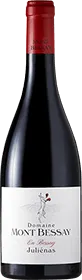
Domaine Mont Bessay : Julienas "En Bessay" 2022

Out of stock
Would you wish to know when this product is back in stock?
Let's talk about this product!
A pairing in mind? A question about the vintage? Comparison with another product? Find the answers here...
Description
Characteristics and tasting tips for the Juliénas "En Bessay" 2022 from Domaine Mont Bessay
Tasting notes
Color
The color is a brilliant ruby.
Nose
The nose is expressive. It combines crisp red fruits (cherry, raspberry, wild strawberry, red currant) with floral notes of peony and violet, along with spice and a hint of pepper. Nuances of morello cherry and blackberry add to this, underpinned by a distinct minerality.
Palate
The palate is supple, juicy and well balanced. Its silky texture rests on fine yet present tannins, while the mineral framework brings tension. The finish, long and savory, remains fresh and perfumed.
Food and wine pairing
This Juliénas pairs well with roast chicken and, more broadly, with roast poultry or white meats. It also suits soft-rind cow's milk cheeses, as well as fine charcuterie. Designed for the table, it is a true gastronomic wine.
Serving and cellaring
Decanting is recommended before serving the Juliénas "En Bessay" 2022.
A high-altitude Gamay Juliénas with pure fruit and a mineral backbone
The estate
Domaine Mont Bessay was born in 2021 on the granitic heights of Juliénas, in the north of Beaujolais, on the border with Burgundy. It is owned and co-managed by Philippe Pascal and Guillaume Marko, who are also co-managers of Domaine du Cellier aux Moines in Givry, in the Côte Chalonnaise. Assisted by the enologist Paul-Clément Tesson, technical director, they follow a Burgundian approach, with parcel-by-parcel selection, certified organic viticulture and biodynamics. The estate farms parcels in Juliénas, Moulin-à-Vent, Saint-Amour and Saint-Véran, with a planned capacity of around 12 hectares.
The vineyard
This Juliénas comes from the lieu-dit "En Bessay". Its eight hectares occupy the upper part of Mont Bessay, at the summit of the Juliénas appellation, with a due south exposure, between 360 and 480 meters in altitude. The soils form a mosaic. There is a very stony pink granite to the east, sandstone on the ridge separating En Bessay from Saint-Amour, then blue stones and deeper decomposed granites towards the west. For this vintage, the cuvée comes from 2.5 hectares of pink granite, planted at around 450 meters in altitude. The vines were planted between 1952 and 1990, and replanting using massal selection is under way from 2022 to 2025 to replace older clones. The vineyard is farmed to certified organic standards, with biodynamic practices. The vines are trellised, hedges have been planted to limit erosion and promote biodiversity, and herbal remedies are used to reduce copper and sulfur doses.
The vintage
In 2022, yields were low from the outset. The vintage was hot, marked by episodes of heat and drought in many French regions. Harvest began on August 29, a month earlier than in 2021. The estate's altitude helped avoid overly rapid ripening.
Vinification and aging
For the Juliénas "En Bessay" 2022, the grapes are hand-harvested and brought to the winery in small perforated crates. They are then sorted on a vibrating table, and lots that do not meet the required standard go into the estate's second wine, Les Amourettes. The harvest is mostly whole-bunch, and bunches deemed imperfect are destemmed and vinified separately. Fermentation, in temperature-controlled tanks, starts spontaneously with indigenous yeasts after about a week at low temperature. Maceration lasts around three weeks, with gentle extraction and foot punch-downs. The wine is then aged for two winters in neutral oak barrels that are 3 to 5 years old, from the Givry estate. Bottling took place on March 1, 2024.
Grape variety
Gamay.