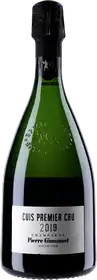
Pierre Gimonnet et Fils : Spécial Club Blanc de Blancs 2016
In stock. Available for pick-up at store
Let's talk about this product!
A pairing in mind? A question about the vintage? Comparison with another product? Find the answers here...
Description
Tasting Notes and Serving Tips for the Spécial Club Blanc de Blancs 2016 by Pierre Gimonnet et Fils
Tasting
Color
The wine shows a pale gold hue with bright highlights, animated by a fine, steady stream of bubbles that build into an elegant, persistent mousse.
Nose
The nose opens on fresh citrus and white fruit, soon joined by white flowers and notes of brioche and pastry. With a little aeration, hints of toasted hazelnut and dried fruit emerge, layered over a distinct chalky, mineral backdrop.
Palate
The palate is silky and creamy, carried by a lively, racy acidity that keeps the wine fresh and energetic despite its generous texture. The finish is long, saline and chalky, with lingering notes of citrus zest and white fruit that recall the chardonnay's chalk-soil origins.
Food and wine pairings
This Blanc de Blancs pairs beautifully with seafood such as scallops, lobster and other delicate fish preparations, as well as with white meats served in creamy, mushroom-based sauces. It also matches nicely with well-aged cheeses, whose nutty, lactic notes echo the wine's own brioche and hazelnut character.
Serving and cellaring
The Spécial Club Blanc de Blancs 2016 is best enjoyed at a serving temperature of around 9°C, allowing its aromatic layers to unfold gradually in the glass. Already expressive today, it also benefits from the five years it spent aging on its lees before disgorgement, which gives it real potential for further development in the cellar.
Other characteristics
Made entirely from chardonnay, this is an extra brut Champagne with a dosage of about 5 grams per liter, a low level of residual sugar that preserves the wine's tension and chalky freshness. Malolactic fermentation was carried out in full, softening the acidity while keeping the wine's mineral backbone intact.
A Côte des Blancs Champagne built on old-vine chardonnay from Cramant and Chouilly
The Estate
Pierre Gimonnet et Fils is a family Champagne house based in Cuis, in the heart of the Côte des Blancs, whose winegrowing roots trace back to 1750, though the family began vinifying and selling its own Champagne in the 1930s. Today the estate is co-run by brothers Olivier and Didier Gimonnet, the third generation to lead the business. Known for its parcel-by-parcel approach to winemaking and its vineyard largely classified as Grand Cru and Premier Cru, the house has built a reputation for precise, chalk-driven chardonnay Champagnes.
The Vineyard
The grapes for this cuvée come from some of the estate's finest Champagne terroirs on the Côte des Blancs: Cramant and Chouilly, both classified Grand Cru, and Cuis, a Premier Cru village. These chalky-soil plots include vines planted as far back as 1911 and 1913, now more than a century old. The vineyard is tended with a reasoned, meticulous approach that limits chemical inputs, encourages biodiversity and pushes roots deep into the chalk in search of minerality.
The Vintage
The 2016 growing season in Champagne was marked by sharp contrasts. Spring brought severe frost episodes along with heavy rainfall that encouraged mildew pressure, reducing yields in several plots. The following summer turned very dry, slowing berry development and exposing young grapes to intense heat. Despite these challenging conditions, the vines that withstood the stress produced fruit with a notably harmonious balance between ripeness and freshness.
Winemaking and aging
For the Spécial Club Blanc de Blancs 2016, grapes were harvested by hand and pressed using the traditional fractionation method, followed by cold settling to clarify the juice. Fermentation took place under controlled temperatures, with malolactic fermentation carried out in full. The wine was then aged for about eight months on its lees in neutral stainless steel tanks, before cold stabilization and clay filtration ahead of bottling for the second fermentation in April 2017. It subsequently rested on its lees in bottle for more than five years, with disgorgement taking place roughly three months before shipping.
Grape Varieties
This cuvée is made from 100% chardonnay, sourced exclusively from Grand Cru and Premier Cru plots on the Côte des Blancs.